
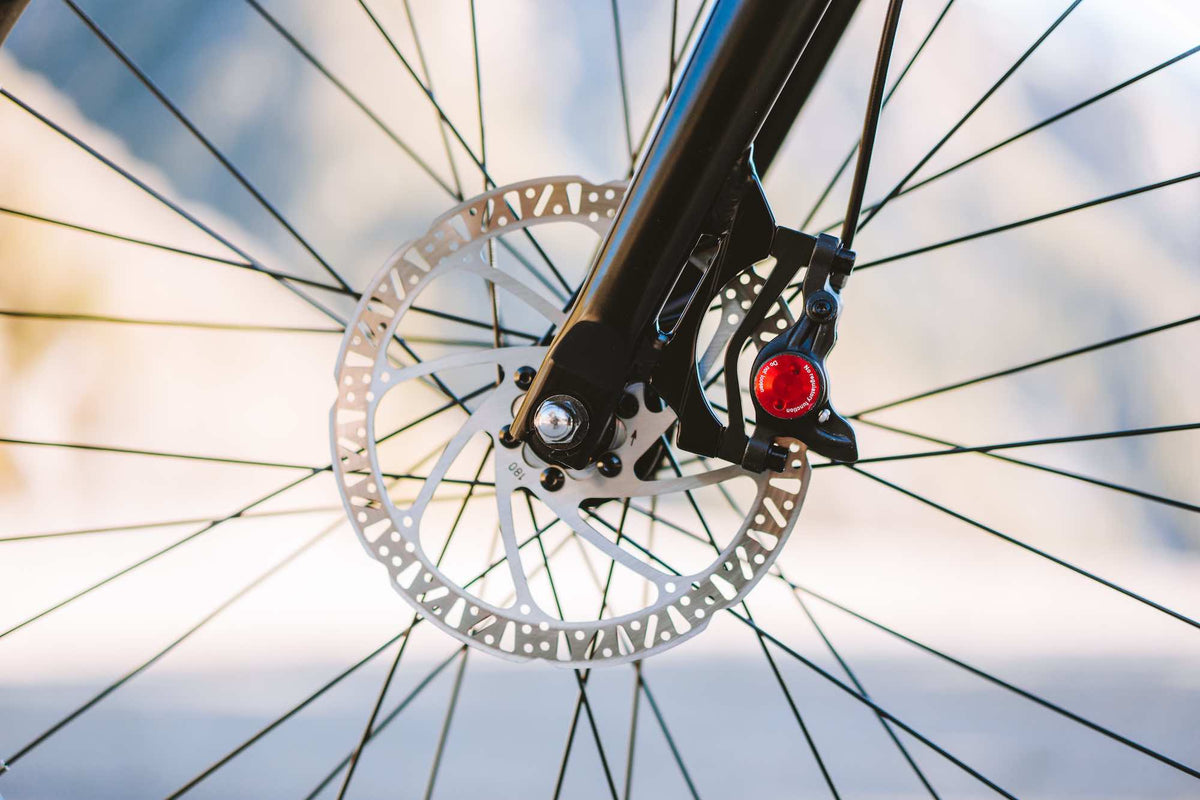
Almost all high-quality eBikes on the market will use disc brakes, and those disc brakes can be one of two common styles: mechanical or hydraulic. While both systems have their merits, it’s worth taking a look at their pros and cons to help you decide.
Shopping for an eBike that uses rim brakes instead of disc brakes? Tread carefully. Electric bicycles need disc brakes because they are heavier, travel faster, and require more braking power to stop safely. Rim brakes should only be used on casual, low-speed eBikes.
What Mechanical & Hydraulic Disc Brakes Have in Common:
Mechanical and hydraulic disc brake systems both use a caliper that sits over a steel rotor. When the rider pulls the brake lever, the brake pads are pressed against the rotor, creating friction (which dissipates as heat) that slows the eBike. The brake pads and rotors are the wear items in the system and need occasional replacement, regardless of whether they operate mechanically or hydraulically.
Mechanical Disc Brakes

In a mechanical disc brake system, the brake lever is connected to the caliper via a steel cable that runs through a housing (as with “classic” caliper, cantilever, or V-brakes). The lever pulls the cable while the housing remains stationary, thereby forcing the pads to move closer to the rotor.
When the rider releases the lever, a spring in the caliper and the return springs in the brake levers pull the cable back in the opposite direction, allowing the pads to retract from the rotor.
Mechanical disc brakes have some key benefits:
- Less expensive than hydraulic disc systems.
- For home mechanics, mechanical systems can be easier to maintain than hydraulic.
- Fewer specialty tools are required, and the ones that are are shared with rim-brake bikes, so many users already own them.
- No fluid to spill during service.
- Mechanical disc brakes are often maintenance-free or very low-maintenance.
Downsides of mechanical disc brakes:
- While mechanical disc brakes still have plenty of braking power for most riders, their braking power is lower than that of the best hydraulic systems.
Hydraulic Disc Brakes

Hydraulic disc brakes are a higher-end solution and are typically found on more expensive, performance-oriented eBikes - especially mountain bikes ridden on steep, off-road terrain.
In a hydraulic disc brake system, there are no cables. Instead, pulling the lever pushes on a reservoir filled with hydraulic fluid (DOT fluid or mineral oil, depending on the brand/model). The force of the fluid pushes on a piston, with the brake pad sitting on the end of the piston. Releasing the lever returns the piston, and thus the brake pads, to the original position.
Benefits of hydraulic disc brakes include:
- Best possible ultimate braking power and modulation.
- Less hand fatigue on long descents.
- A very long service interval.
- Require no maintenance under short intervals in normal conditions, and need the fluid replaced and the system bled very rarely - perhaps years between service, for most riders.
There are some downsides:
- Specialty tools are required to trim hydraulic lines to length, fill them with fluid, and bleed the system.
- More expensive compared with mechanical systems.

Choosing What's Right for You
Both mechanical and hydraulic disc brakes can stop an eBike safely and reliably. The right choice comes down to your budget, riding style, and how you'd prefer to handle maintenance.
If you value simplicity, lower upfront cost, and the ability to service your own brakes without specialty tools, mechanical disc brakes are a smart, dependable choice. If you're riding aggressively on steep or technical terrain, or you simply want the strongest possible stopping power with the least amount of hand fatigue, hydraulic disc brakes are worth the extra investment.
Either way, steer clear of rim brakes! On an eBike's added weight and speed, disc brakes aren't a luxury, they're a safety essential.