
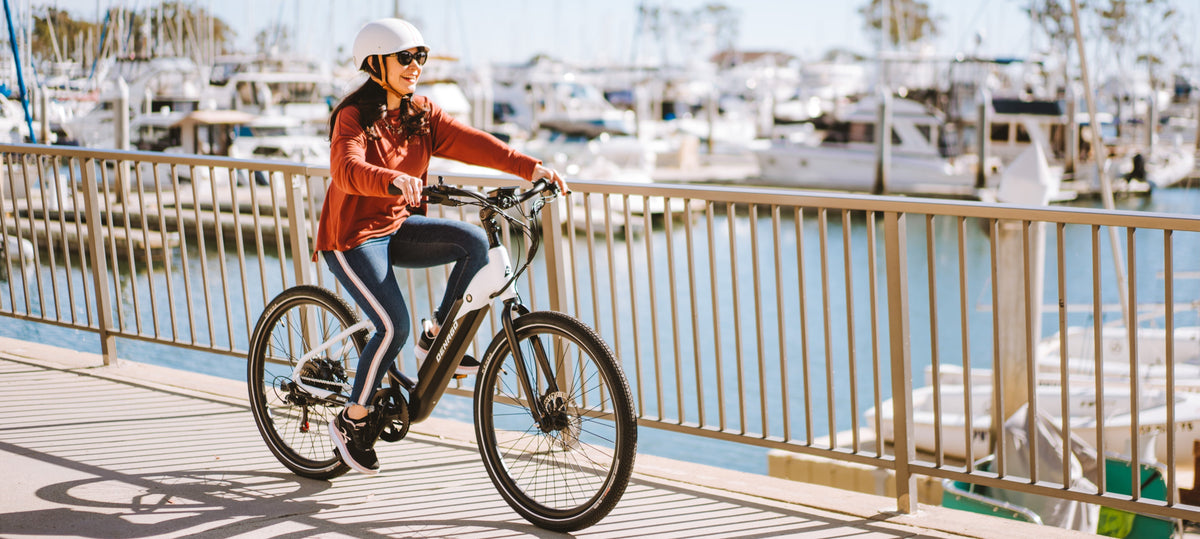
"How far can I go?" is one of the most common questions asked by eBike buyers. The answer—an eBike's range—depends on many factors. As with driving a car, mileage is a mix of the vehicle's design and how you use it.
Let's take a look at how eBike range is advertised and the factors that influence it.

What Affects eBike Range?
- The capacity of the battery - Bigger capacities produce more range.
- Rider weight - Heavier riders consume battery capacity faster and thus get less range, all other factors being equal.
- Hills - Is the terrain flat? Or hilly? EBike motors must work harder on hills, which consumes energy and reduces range.
- Headwinds - As with hills, eBike motors consume more energy with a headwind than a tailwind.
- Use of throttle - Some eBike models feature a throttle that can engage the electric motor to propel the rider without pedaling. Throttle use drains the battery faster than pedal assist, reducing range.
- Rider contribution - When riding a pedal-assist eBike, power comes from two sources: the rider's legs and the electric motor. If you're barely pedaling, expect reduced range as the electric motor does most of the work. Riders who contribute with their legs can significantly improve range.
Real-World eBike Range
When shopping for an eBike, it's useful to compare real-world range statistics. EBikes aren't ridden in ideal conditions in a lab. Consider choosing a brand that publishes range figures that reflect your actual likely usage patterns: "this eBike achieved a range of 35 miles in pedal assist level 3 when ridden by a 170 lb rider on flat ground" is useful, whereas a published range of "up to 40 miles" doesn't give you much idea of what to expect.

How Much Range Do You Need?
More range isn't necessarily better. Batteries are among the heaviest components on an eBike, so adding a larger battery in hopes of more range isn't necessarily ideal. Instead, choose a "right-sized" eBike battery - one that has enough capacity to meet most of your range requirements, without too much extra.
If you typically ride 10 miles at a time, an eBike with a 50-mile range may be a needless extra expense. Keep in mind some strategies to replenish your battery: For example, if you commute to work by eBike, keeping a second charger at your workplace means you only need enough range for the one-way trip, not the round trip. Some riders may also choose to bring along a second battery on very long rides — if one dies, all they need to do is swap it out and get going again.
Finding Your Right-Sized Range
Range isn't a single number you can compare across brands, it's a moving target shaped by your weight, the terrain, the weather, and how much work you put in yourself. Rather than chasing the highest advertised max, focus on real-world figures that match your actual riding conditions, and choose a battery sized for the rides you'll actually take, not the rare exception.
With a little planning, whether that's a spare charger at work or a backup battery for long days out, you can get all the range you need without paying for capacity you'll never use.