
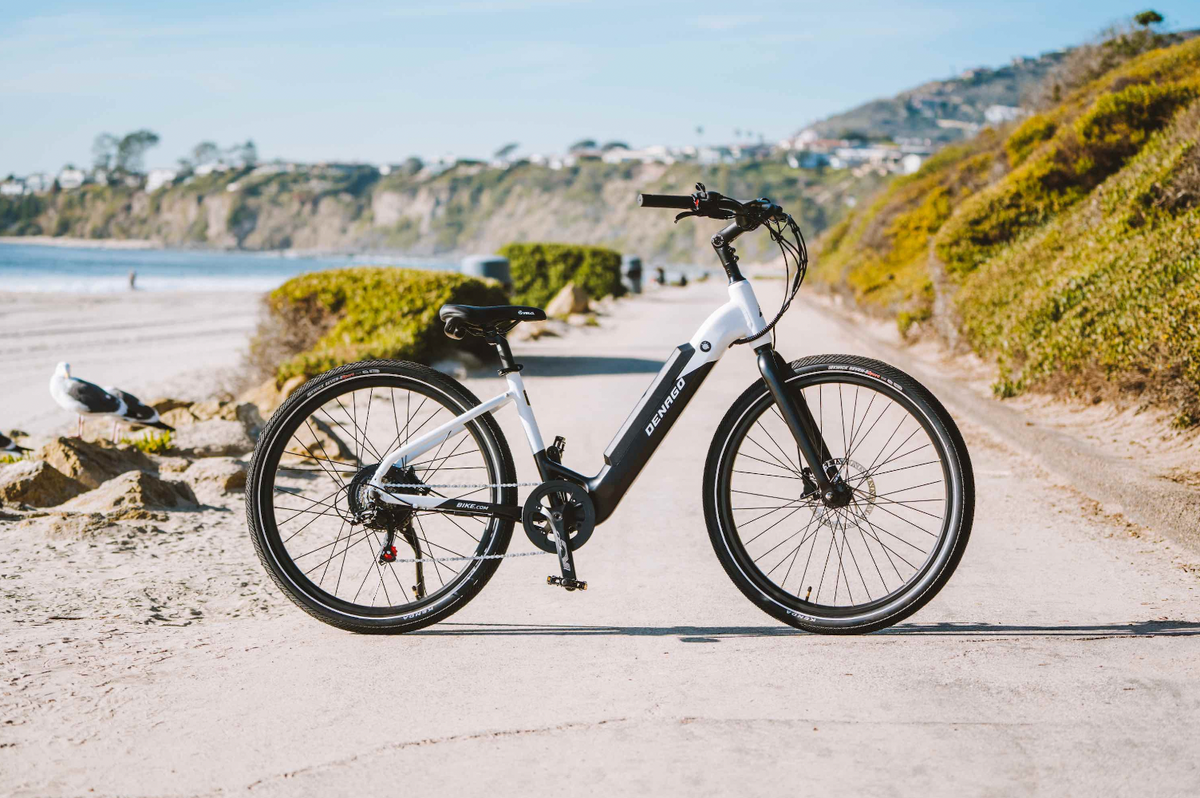
The step-thru version of a commuter eBike is, for many riders, the only version that matters. An ultra-low standover height means you can hop on and off without swinging a leg over a top tube, and that alone sells a lot of bikes. Denago knows this, which is why the City 1 Step-Thru sits near the top of its lineup as a cutting-edge urban commuter.
The City 1 checks a lot of boxes that buyers care about: a 500W rear-hub motor with a 750W peak, a sizable 652.8 Wh LG-cell battery, hydraulic disc brakes on both wheels, an 8-speed drivetrain, and a claimed range of up to 60 miles.
However, range claims on eBikes are notoriously optimistic because they're usually generated under best-case conditions: warm weather, a light rider, flat ground, and the lowest assist level. So rather than take Denago's "up to 60 miles" at face value, we're breaking down five separate range runs across a spread of rider weights, temperatures, elevation profiles, and assist levels to show what kind of range you can actually expect depending on how you ride it.

Denago City 1 Step-Thru Specs
Key Specs |
Claimed vs. Tested |
| Motor | 500W Rear Hub (750W peak), 50 Nm torque |
| Top Speed | 28 mph on pedal assist, 20 mph on throttle |
|
Battery |
48V 13.6Ah LG cell (652.8 Wh) |
| Claimed Range | Up to 60 miles |
| Tested Range | 20–48 miles, depending on mode, terrain, and conditions |
| Brakes | Hydraulic disc, front and rear |
| Frame | 6061-T6 aluminum alloy, step-thru |
| Payload Capacity | 300 lbs |
| Price |
$1,299 |
Design and Build

Rating: ★★★½
The City 1 Step-Thru is built with a 6061-T6 aluminum alloy frame that contains a low top tube, the kind of design that lets a 5'2" rider swing on without hiking a leg up. Its standover height measures 21 inches, and the adjustable stem lets you raise or lower the handlebar depending on your build. Denago pairs that with a wide, padded Velo saddle with a built-in lift handle, which is a small but useful touch when you're carrying the bike up a curb or into a bike rack.

The bike offers a fair balance of high-quality components for its price point. For only $1,299, you get a Shimano Tourney 7-speed derailleur, an 8-speed KMC chain, a 42-tooth aluminum alloy crankset with a built-in chain guard to protect pant legs, Kenda Kwick Seven.5 tires (27.5 x 2.2") with K-Shield puncture protection and reflective sidewalls for extra visibility at night, and hydraulic disc brakes in both the front and the rear.

Its backlit LCD display keeps you updated on your bike’s stats as you ride, showing its speed, motor power, trip distance, odometer, trip time, and battery level. Additionally, it features a PIN-lock security system and a walk-assist mode for pushing the bike up steps or steep terrain without pedaling. A left-side thumb throttle lets you ride without pedaling at all, capped at 20 mph, while pedal assist allows you to travel up to 28 mph across five levels.
Performance Testing: Real-World Range

Rating: ★★★
Denago's official spec sheet claims up to 60 miles of range, but that number, like most manufacturer estimates, comes from the most forgiving scenario possible: a light rider, low assist, flat pavement, mild weather. Real commutes rarely look like that, so we pulled together data from five separate range tests, run across a mix of throttle-only and pedal-assist riding, different rider weights, temperatures from the teens to the mid-60s, and terrain ranging from pancake-flat to over 2,000 feet of climbing.
| Test | Mode | Range | Rider Weight | Assist Level | Temperature | Terrain |
| #1 | Throttle | 23 miles | 250 lbs | 100% throttle | 38°F | 401 ft of elevation gain |
| #2 | Throttle | 37 miles | 155 lbs | 100% throttle | 65°F | 2,170 ft of climbing |
| #3 | Pedal Assist | 20 miles | 185 lbs | PAS 5 | 13°F | 200 ft of elevation gain |
| #4 | Pedal Assist | 48 miles | 175 lbs | PAS 1 | 60°F | Flat terrain |
| #5 | Pedal Assist | 29 miles | 175 lbs | PAS 3 | 55°F | Flat terrain |
A few things stand out immediately:
Throttle-only range is highly rider and terrain-dependent. Test #1 and Test #2 were both 100%-throttle runs with no pedaling, yet they landed 14 miles apart; 23 miles versus 37 miles. The gap comes down to rider weight (250 lbs versus 155 lbs) and near-freezing temperatures in Test #1 versus a mild 65°F in Test #2. Heavier riders and cold weather both tax lithium batteries harder, and running the motor at 100% output the entire time, rather than contributing any pedal power, is the single fastest way to burn through a charge on any eBike.
Pedal assist level matters more than almost anything else. Tests #4 and #5 were run under nearly identical conditions with the same 175-lb rider, flat terrain, similar mild temperatures. The only real variable is the assist level. Dropping from PAS 3 (29 miles) to PAS 1 (48 miles) nearly doubled the range. That shows just how much control you have over your own range simply by choosing a lower assist level and contributing more of your own pedal power.

Cold weather and high assist levels stack against you. Test #3 produced the shortest range of the group, just 20 miles, despite being a pedal-assist run rather than throttle-only. The combination of PAS 5 (the highest, most motor-hungry setting) and a bitterly cold 13°F is a worst-case scenario for any lithium battery, and it shows. Even with the rider pedaling, that's less range than either of the throttle-only tests.
The 60-mile claim is achievable, but only under specific conditions. None of the five runs here hit 60 miles, and that tracks with what we generally see when we compare manufacturer range claims to real riding. Denago's own advertised range chart pairs its "up to 60 miles" figure with the lowest pedal assist level, flat ground, minimal stop-and-go, and a rider around 176 lbs. This reflects Test #4's conditions, which came closest to that ceiling at 48 miles. If you ride mostly on throttle, carry extra weight, climb hills, or ride in the cold, it is best to plan around 20–30 miles of range instead.
Ride Quality and Handling

Rating: ★★★★½
The upright, comfort-oriented geometry is the City 1's strongest selling point in daily use. The adjustable riding position puts your hands on a wide handlebar with your back relatively straight, which makes it easy to see traffic and stay aware while riding in the city. Combined with the padded saddle and the low step-thru frame, it's an effortless and comfortable ride for short trips to the store or a longer daily commute.

The 500W hub motor (peaking at 750W) provides confident power whether you're relying on the throttle in stop-and-go traffic or letting pedal assist do the work on a longer ride. With 50 Nm of torque, it handles many kinds of terrain with ease. However, it’s worth mentioning that as the range data above shows, leaning on higher assist levels or throttle-only riding on hillier routes will noticeably shorten your range.

The hydraulic disc brakes are a genuine highlight. Stopping power is confident and easy to adjust, which matters in city riding where you're constantly managing traffic, pedestrians, and unpredictable stops. The Kenda tires' K-Shield puncture protection is a practical addition for commuters who don't want to worry about flats on the way to work.
Pros & Cons

Pros:
- Large 652.8 Wh battery gives real flexibility to trade range for power depending on how you ride
- Dual hydraulic disc brakes offer ultimate stopping power
- Ultra-low step-thru frame and adjustable stem make it easy to fit a wide range of riders
- Comfortable, upright riding position with a well-padded saddle for longer rides
- Puncture-resistant tires with reflective striping add real-world commuting value
- Straightforward LCD display with walk-assist mode and PIN-lock security
Cons:
- Real-world range varies dramatically with assist level, rider weight, and temperature, the 60-mile claim only applies in near-ideal conditions
- Higher pedal-assist levels (PAS 4-5) draw down the battery quickly; riders who want maximum range will need to stay in PAS 1-2
Quick Tips: Getting the Most From Your City 1

Favor lower assist levels. Our data shows PAS 1 nearly doubled the range of PAS 3 under otherwise identical conditions. If maximizing distance matters more than maximizing speed, start low and only bump up assist when you need it.
Mix in pedaling, especially in cold weather. Throttle-only riding in near-freezing temperatures produced the shortest ranges in our testing outside of high-PAS cold riding. A little pedal input goes a long way toward preserving range when the battery is already working harder in the cold.
Expect less range on hilly routes. Even a throttle-only run with a lighter rider and mild weather saw its range affected by over 2,000 feet of climbing. Consider that you may need an extra charge if your commute has a substantial elevation change.
Keep the battery out of the cold when possible. Lithium batteries lose usable capacity in low temperatures; storing the bike somewhere warmer between rides, when practical, will help close some of that gap.
Is the Denago City 1 Step-Thru Worth It?

Overall Rating: ★★★¾
The Denago City 1 Step-Thru is a comfortable, well-equipped commuter with hydraulic brakes, a genuinely large battery, and an accessible step-thru frame that will fit a wide range of riders, all for $1,299. It's a strong option if you want a comfortable and powerful city bike for your commuting needs.
Where it asks for a little buyer education is the range claim. "Up to 60 miles" is technically true under best-case conditions, but its real-world range settles closer to 20 to 40 miles. That's still plenty for the average commute, but riders who require more mileage may want to bring along a spare battery.
For city and suburban commuters who value comfort, easy on/off access, and strong brakes, the City 1 Step-Thru is a well-rounded and worthy pick at an exceptional value.